LLM 负载均衡与高可用机制
1. 概述 (Overview)
在构建基于大语言模型(LLM)的企业级应用时,单一模型往往无法满足所有场景需求(如成本、速度、能力差异)。同时,外部模型服务可能存在不稳定性。
Agents-Flex 提供了一套生产就绪的 Model Router(模型路由) 机制,旨在解决以下核心问题:
- 多模型管理:统一接入 OpenAI, Qwen, DeepSeek, Claude 等不同厂商的模型。
- 智能负载均衡:根据实时负载、权重或随机策略分发请求。
- 高可用保障:通过熔断器(Circuit Breaker)防止故障节点拖垮系统。
- 自动重试:在遇到临时故障时自动切换节点或重试。
- 标签路由:根据业务需求(如“需要视觉能力”、“需要低成本”)动态选择模型。
本文档将深入解析 负载均衡 与 高可用机制 包下的核心设计与实现。
2. 核心架构 (Core Architecture)
模型路由的核心由以下四个组件协同工作:
- ModelEndpoint: 模型节点的抽象,包含真实模型实例、运行时指标、状态和标签。
- EndpointMetrics: 轻量级、无锁的运行时指标统计(活跃数、成功率、延迟等)。
- ModelLoadBalancer: 负载均衡策略接口及实现。
- CircuitBreaker: 熔断器,保护系统免受持续失败的模型影响。
- AbstractModelRouter: 路由执行引擎,整合上述组件完成请求调度。
graph TD
    User[用户请求] --> Router[AbstractModelRouter]
    Router --> Filter[过滤: 状态/标签/熔断]
    Filter --> LB[负载均衡器 ModelLoadBalancer]
    LB --> Endpoint[选中 ModelEndpoint]
    Endpoint --> Metrics[更新 EndpointMetrics]
    Endpoint --> CB[熔断器 CircuitBreaker]
    Endpoint --> Model[真实 LLM 调用]
    Model -->|成功| CB_RecordSuccess[记录成功]
    Model -->|失败| CB_RecordFailure[记录失败 & 重试判断]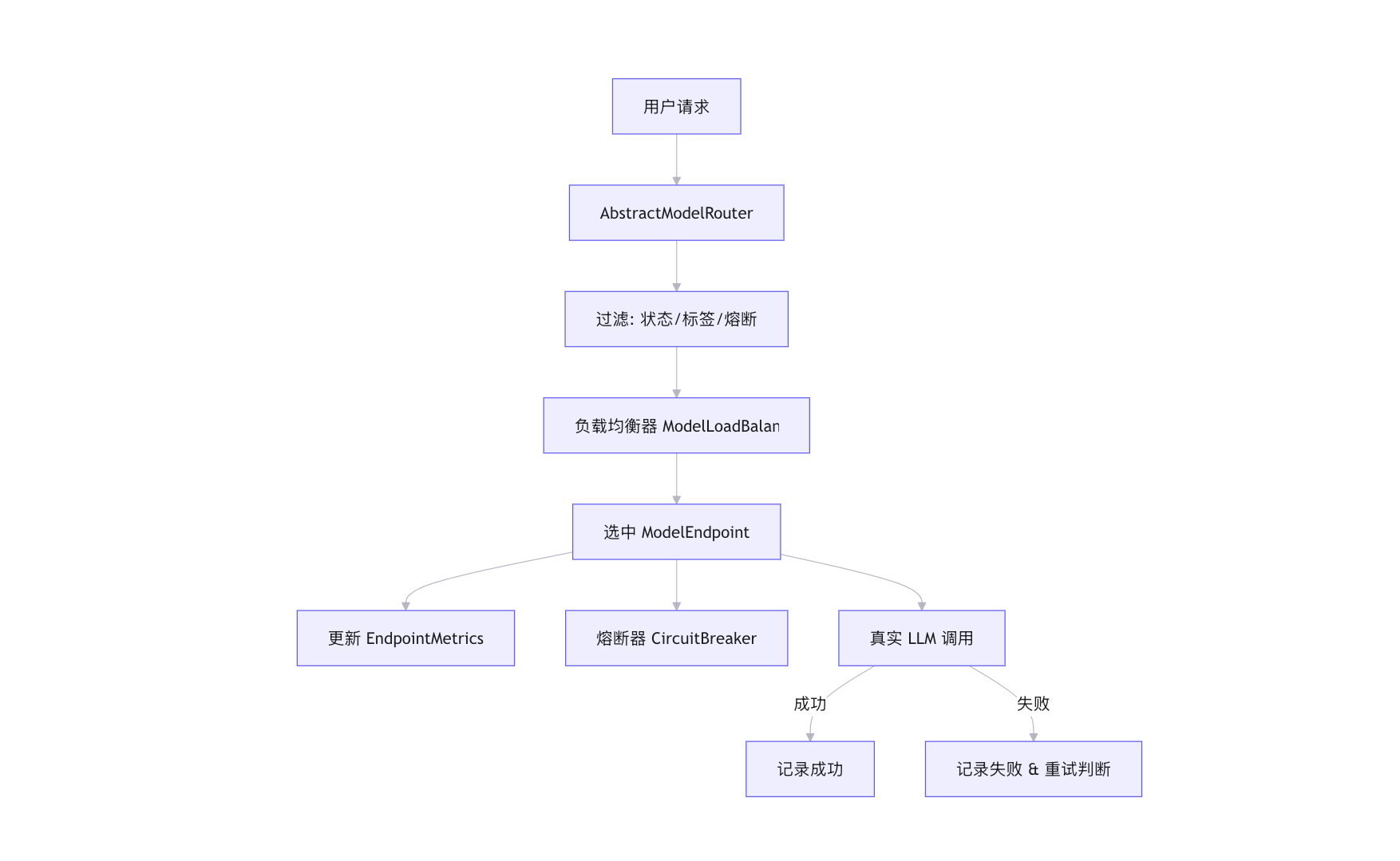
3. 核心组件详解
3.1 ModelEndpoint (模型节点)
ModelEndpoint<T> 是路由系统的基本单元,代表一个具体的模型实例。
关键属性:
model: 真实的模型对象(如ChatModel, `EmbeddingModel)。metrics:EndpointMetrics实例,记录该节点的实时运行数据。status:EndpointStatus(UP, DOWN, HALF_OPEN),当前节点健康状态。weight: 权重,用于加权随机负载均衡。tags: 标签集合,用于功能匹配(如vision,reasoning,cheap)。consecutiveFailures: 连续失败次数,用于熔断判断。
代码示例:
// 创建一个带有标签和权重的节点
ModelEndpoint<ChatModel> endpoint = new ModelEndpoint<>(myQwenModel);
endpoint.setWeight(10);
endpoint.addTags(Set.of("cheap", "fast"));
3.2 EndpointMetrics (运行时指标)
为了追求极低开销和高并发安全,EndpointMetrics 完全基于 JVM 内存态原子类 (AtomicInteger, AtomicLong)实现,不依赖 Prometheus 或 OpenTelemetry 等重型观测系统。
核心指标:
activeRequests: 当前正在执行的请求数(用于最少活跃负载均衡)。totalRequests: 总请求数。successRequests/failedRequests: 成功/失败计数。totalLatencyMs: 总延迟毫秒数。
计算方法:
successRate(): 成功率 (0.0 - 1.0)。avgLatencyMs(): 平均响应延迟。
注意:
beginRequest()必须在调用模型前执行。endRequest()必须在finally块中执行,确保活跃计数正确释放。recordSuccess(latency)和recordFailure(latency)用于更新统计和熔断状态。
3.3 EndpointStatus (节点状态机)
节点状态遵循标准的熔断状态流转:
- UP: 正常状态,接受请求。
- DOWN: 熔断状态,拒绝请求。当连续失败次数达到阈值时进入此状态。
- HALF_OPEN: 半开状态,尝试恢复。当熔断冷却时间结束后进入此状态,允许少量请求探测。若成功则转为 UP,若失败则回到 DOWN。
3.4 ModelLoadBalancer (负载均衡器)
接口定义:
public interface ModelLoadBalancer<T> {
    ModelEndpoint<T> select(List<ModelEndpoint<T>> endpoints);
}
内置实现:
LeastActiveLoadBalancer (推荐)
- 原理: 选择当前
activeRequests最小的节点。若相同,则选择平均延迟最低的。 - 适用场景: AI 模型推理耗时差异大,此策略能最好地平衡后端压力,避免慢节点堆积请求。
- 代码逻辑:java
endpoints.stream()
    .min(Comparator.comparingInt(e -> e.getMetrics().activeRequests())
                   .thenComparingLong(e -> e.getMetrics().avgLatencyMs()))
- 原理: 选择当前
WeightedRandomLoadBalancer
- 原理: 根据
weight属性进行加权随机选择。 - 适用场景: 希望按比例分配流量(例如:80% 流量给便宜模型,20% 给高质量模型)。
- 原理: 根据
(注:RoundRobin 和 LowestLatency 也可通过实现接口轻松扩展)
3.5 CircuitBreaker (熔断器)
接口定义:
public interface CircuitBreaker<T> {
    boolean allowRequest(ModelEndpoint<T> endpoint);
    void recordSuccess(ModelEndpoint<T> endpoint);
    void recordFailure(ModelEndpoint<T> endpoint);
}
DefaultCircuitBreaker 默认实现:
- 配置参数:
failureThreshold: 连续失败阈值(默认 5 次)。recoverMs: 熔断后的冷却/恢复时间(默认 30,000 ms)。
- 逻辑:
- allowRequest: 若状态为 UP,允许;若为 DOWN,检查是否超过
recoverMs,若是则转为 HALF_OPEN 并允许;否则拒绝。 - recordSuccess: 清空连续失败计数,状态重置为 UP。
- recordFailure: 增加连续失败计数,若达到阈值,状态设为 DOWN。
- allowRequest: 若状态为 UP,允许;若为 DOWN,检查是否超过
3.6 RetryPolicy (重试策略)
- DefaultRetryPolicy: 简单基于最大重试次数。
- 扩展性: 开发者可实现更复杂的策略(如指数退避、特定异常不重试等)。
4. 路由执行流程 (Execution Flow)
AbstractModelRouter.execute() 方法是核心入口,其执行逻辑如下:
- 过滤候选节点 (
filterEndpoints):- 排除状态为
DOWN的节点。 - 调用
circuitBreaker.allowRequest()排除处于熔断冷却期的节点。 - 根据请求携带的
tags进行标签匹配 (matchTags)。
- 排除状态为
- 检查可用性: 若无候选节点,抛出
RouterException。 - 负载均衡: 调用
loadBalancer.select()选择一个最佳ModelEndpoint。 - 开始计时: 调用
endpoint.getMetrics().beginRequest()。 - 执行调用: 通过
ModelInvoker执行真实模型调用。 - 结果处理:
- 成功:
- 计算延迟。
metrics.recordSuccess(latency)。circuitBreaker.recordSuccess(endpoint)。- 返回结果。
- 失败:
- 计算延迟。
metrics.recordFailure(latency)。circuitBreaker.recordFailure(endpoint)。- 捕获异常。
- 成功:
- 重试判断:
- 若
retryPolicy.shouldRetry()返回 true,且还有重试机会,回到步骤 1(重新过滤和选择,可能切换到其他节点)。 - 若不可重试,跳出循环。
- 若
- 最终清理:
finally块中调用endpoint.getMetrics().endRequest()。 - 异常抛出: 若所有尝试均失败,抛出包含最后异常的
RouterException。
5. 使用指南 (Usage Guide)
5.1 快速开始:使用默认配置
RoutedChatModel 提供了便捷的构造函数,自动配置最少活跃负载均衡、3次重试和默认熔断器。
import com.agentsflex.core.model.router.RoutedChatModel;
import com.agentsflex.llm.chat.ChatModel;
import java.util.List;

// 假设已有多个 ChatModel 实例
ChatModel qwenModel = ...;
ChatModel gptModel = ...;
ChatModel deepseekModel = ...;

List<ChatModel> models = List.of(qwenModel, gptModel, deepseekModel);

// 创建路由模型
ChatModel routedModel = new RoutedChatModel(models);

// 像使用普通模型一样使用它
AiMessageResponse response = routedModel.chat(prompt, options);
5.2 高级配置:自定义策略
若需精细控制负载均衡、熔断阈值或标签路由,请使用全参构造函数。
import com.agentsflex.core.model.router.endpoint.ModelEndpoint;
import com.agentsflex.core.model.router.balance.WeightedRandomLoadBalancer;
import com.agentsflex.core.model.router.breaker.DefaultCircuitBreaker;
import com.agentsflex.core.model.router.retry.DefaultRetryPolicy;
import java.util.Set;

// 1. 创建 Endpoints 并配置权重和标签
ModelEndpoint<ChatModel> ep1 = new ModelEndpoint<>(qwenModel);
ep1.setWeight(5);
ep1.addTags(Set.of("cheap"));

ModelEndpoint<ChatModel> ep2 = new ModelEndpoint<>(gptModel);
ep2.setWeight(1);
ep2.addTags(Set.of("high-quality", "vision"));

List<ModelEndpoint<ChatModel>> endpoints = List.of(ep1, ep2);

// 2. 配置组件
// 使用加权随机负载均衡
WeightedRandomLoadBalancer<ChatModel> lb = new WeightedRandomLoadBalancer<>();
// 连续失败 3 次即熔断,冷却 10 秒
DefaultCircuitBreaker<ChatModel> cb = new DefaultCircuitBreaker<>(3, 10000);
// 最多重试 2 次
DefaultRetryPolicy retry = new DefaultRetryPolicy(2);

// 3. 创建路由模型
RoutedChatModel routedModel = new RoutedChatModel(endpoints, lb, retry, cb);

// 4. 调用时指定标签(可选)
ChatOptions options = ChatOptions.builder()
    .metadata("modelTags", Set.of("high-quality")) // 只选择 gptModel
    .build();

AiMessageResponse response = routedModel.chat(prompt, options);
5.3 Embedding 模型路由
RoutedEmbeddingModel 的使用方式与 Chat 模型类似:
List<EmbeddingModel> embeddingModels = List.of(modelA, modelB);
EmbeddingModel routedEmbedding = new RoutedEmbeddingModel(embeddingModels);

VectorData vectors = routedEmbedding.embed(document, options);
6. 扩展开发 (Extension)
6.1 自定义负载均衡器
实现 ModelLoadBalancer<T> 接口:
public class MyCustomLoadBalancer<T> implements ModelLoadBalancer<T> {
    @Override
    public ModelEndpoint<T> select(List<ModelEndpoint<T>> endpoints) {
        // 你的选择逻辑
        return endpoints.get(0);
    }
}
6.2 自定义熔断器
实现 CircuitBreaker<T> 接口,可集成 Sentinel 或 Resilience4j 等成熟框架:
public class SentinelCircuitBreaker<T> implements CircuitBreaker<T> {
    @Override
    public boolean allowRequest(ModelEndpoint<T> endpoint) {
        // 调用 Sentinel API 判断
        return true;
    }

    @Override
    public void recordSuccess(ModelEndpoint<T> endpoint) {
        // 记录成功
    }

    @Override
    public void recordFailure(ModelEndpoint<T> endpoint) {
        // 记录失败
    }
}
6.3 自定义重试策略
实现 RetryPolicy 接口:
public class ExponentialBackoffRetryPolicy implements RetryPolicy {
    private final int maxRetries;

    public ExponentialBackoffRetryPolicy(int maxRetries) {
        this.maxRetries = maxRetries;
    }

    @Override
    public boolean shouldRetry(int retryCount, Throwable throwable) {
        if (retryCount >= maxRetries) return false;

        // 可选:根据异常类型决定是否重试
        // if (throwable instanceof TimeoutException) return true;

        try {
            Thread.sleep((long) Math.pow(2, retryCount) * 1000);
        } catch (InterruptedException e) {
            Thread.currentThread().interrupt();
        }
        return true;
    }
}
7. 最佳实践 (Best Practices)
- 首选 LeastActiveLoadBalancer: 对于 LLM 这种响应时间波动大的服务,最少活跃连接数比轮询更能保证整体吞吐量。
- 合理设置熔断阈值:
failureThreshold: 建议设为 3-5。太小容易误杀,太大反应迟钝。recoverMs: 建议设为 10s-60s。给下游服务足够的恢复时间。
- 利用标签路由: 为模型打上
vision,code,cheap,fast等标签,在业务层根据需求动态指定,实现精细化的成本控制和质量保障。 - 监控 Metrics: 虽然
EndpointMetrics是内存态的,但建议定期采集successRate和avgLatencyMs并上报到监控系统(如 Prometheus),以便观察模型健康度。 - 线程安全:
ModelEndpoint和EndpointMetrics内部已做并发处理,可在多线程环境下安全使用。
8. 常见问题 (FAQ)
Q: 为什么不用 RoundRobin?
A: LLM 的推理时间差异巨大(从几百毫秒到几十秒)。RoundRobin 会导致慢节点堆积大量请求,而快节点空闲。LeastActive 能更好地平衡实际负载。
Q: 熔断后如何自动恢复?
A: DefaultCircuitBreaker 会在 recoverMs 时间后自动将状态从 DOWN 转为 HALF_OPEN,并允许一次试探请求。若成功则恢复 UP,若失败则继续 DOWN。
Q: 如何区分不同业务的模型需求?
A: 使用 tags。例如,代码生成任务要求 tags=["code"],闲聊任务要求 tags=["cheap"]。Router 会自动过滤出符合标签的节点池再进行负载均衡。
Q: Metrics 数据会丢失吗?
A: 是的,EndpointMetrics 是 JVM 内存态的,重启应用后会重置。如需持久化历史数据,需自行对接外部监控系统。